
The Secret to Effortlessly Emptying the Dishwasher with ADHD
Do you ever open the dishwasher and instantly feel resistance? Maybe you even hate emptying the dishwasher?
Or perhaps you’ve even wondered: “How can something this easy to others feel like absolute torture to me?”
It’s not because the task is physically difficult, but because your brain suddenly feels overwhelmed before you even touch a plate. You stare at the cups, the bowls, the random containers, the silverware, the awkward lids, and somehow your brain immediately wants to leave the kitchen and do literally anything else.
The answer is not laziness or lack of discipline. It’s cognitive load.
More specifically, your brain is being forced to process far too many individual decisions and visual categories all at once. And for ADHD brains especially, that can make unloading the dishwasher feel terribly stressful and draining.
But once you understand what’s actually happening, you can redesign the entire process so it becomes dramatically easier. Even to the point where it feels almost automatic.
Why Your Dishwasher Feels Mentally Exhausting
Most people think unloading the dishwasher is one task. But your brain doesn’t experience it that way.
Your brain experiences it as dozens, sometimes hundreds, of tiny micro-decisions:
Where does this go? Does this stack with these bowls or those bowls? Can these cups fit together? Which lid belongs to which container? Should I grab plates first? Should I carry multiple things? Where does this weird serving spoon go again?
That constant decision-making creates cognitive load, and cognitive load is exhausting for ADHD brains — especially when the dishes don’t visually group together easily.
Cognitive load is the amount of mental processing your brain has to do at one time. The higher the cognitive load, the more mentally demanding, stressful, and draining a task feels. And when cognitive load becomes too high, ADHD brains often start experiencing resistance, avoidance, frustration, mental fatigue, or the sudden urge to escape the task entirely.
Why Matching Dishes Make Emptying the Dishwasher Easier
One of the biggest hidden sources of dishwasher stress is visual inconsistency.
When your dishes are all different shapes, sizes, brands, and colors, your brain has a much harder time grouping them together efficiently. Instead of quickly recognizing simple categories like “mugs,” “plates,” or “bowls,” your brain has to keep processing and sorting individual objects one by one.
That increases cognitive load before you even touch a single dish.
But when your dishes match, your brain automatically compresses the information into predictable visual groups. Instead of seeing dozens of unrelated objects, your brain sees a small number of categories that can be processed quickly and easily.
This dramatically lowers the amount of mental effort required to unload the dishwasher.
And once you see the difference visually, it becomes very obvious why one dishwasher feels stressful while the other feels calm and easy to process.
Mismatched Dishes vs Matching Dishes
Take a look at the following photo of a dishwasher loaded with mismatched dishes, and imagine that the dishwasher is yours and you need to empty it right now.
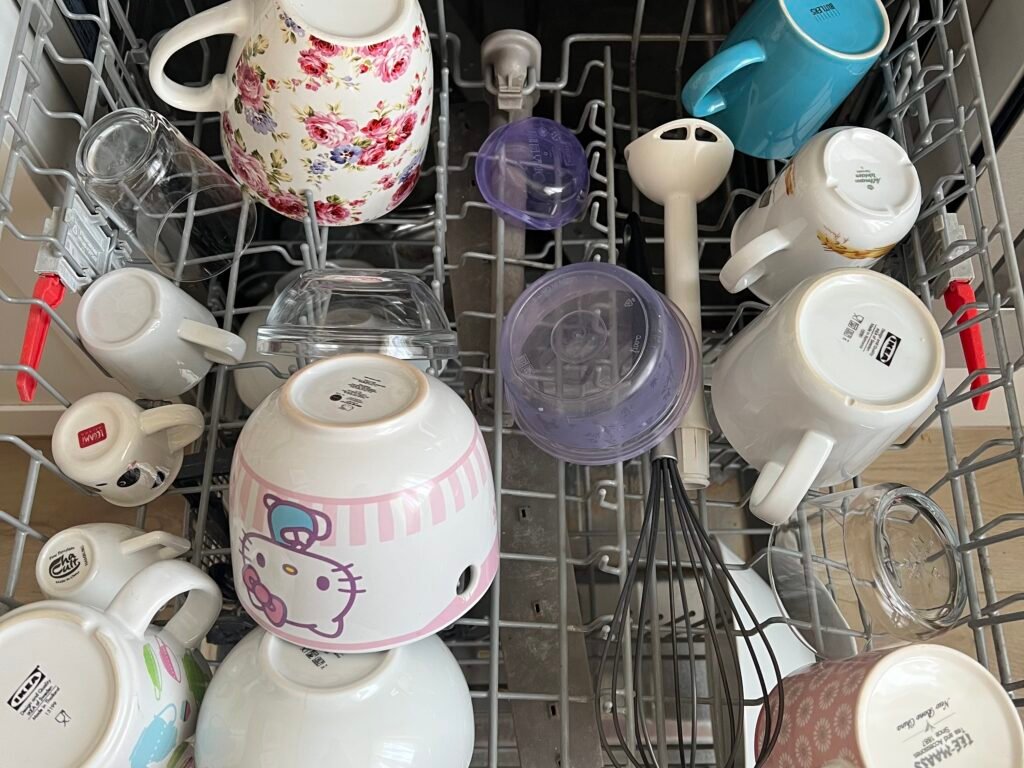
If you look at the photo long enough, you can see that most of the dishes are coffee cups of some sort, and they probably all go in the same cupboard. But now think about this: how do you put them away?
Do you imagine that it would feel a bit annoying because they won’t stack properly due to all the different sizes and shapes? Do you imagine yourself awkwardly trying to fit them all into the cupboard, stacking some of them precariously and hoping nothing protrudes or falls over afterward? Do you picture the cupboard itself looking cluttered and disorganized once everything is shoved back inside?
And what are you going to grab first? And next? Is it immediately obvious, or does your brain hesitate, trying to decide? Do your eyes dart around the dishwasher, unsure where to continue? Does simply looking at the image already create a feeling of stress or mental resistance?
That’s cognitive load.
Because the dishes don’t visually match, your brain has difficulty grouping them together efficiently. Instead of seeing a few simple categories, your brain sees 18 separate objects that all need to be individually processed. That means more visual analysis, more sorting, and more tiny decisions your brain has to make before you even start moving (and the entire time you’re emptying the dishwasher).
Now let’s move on to the next photo. Again, imagine this is your dishwasher that you now need to empty.
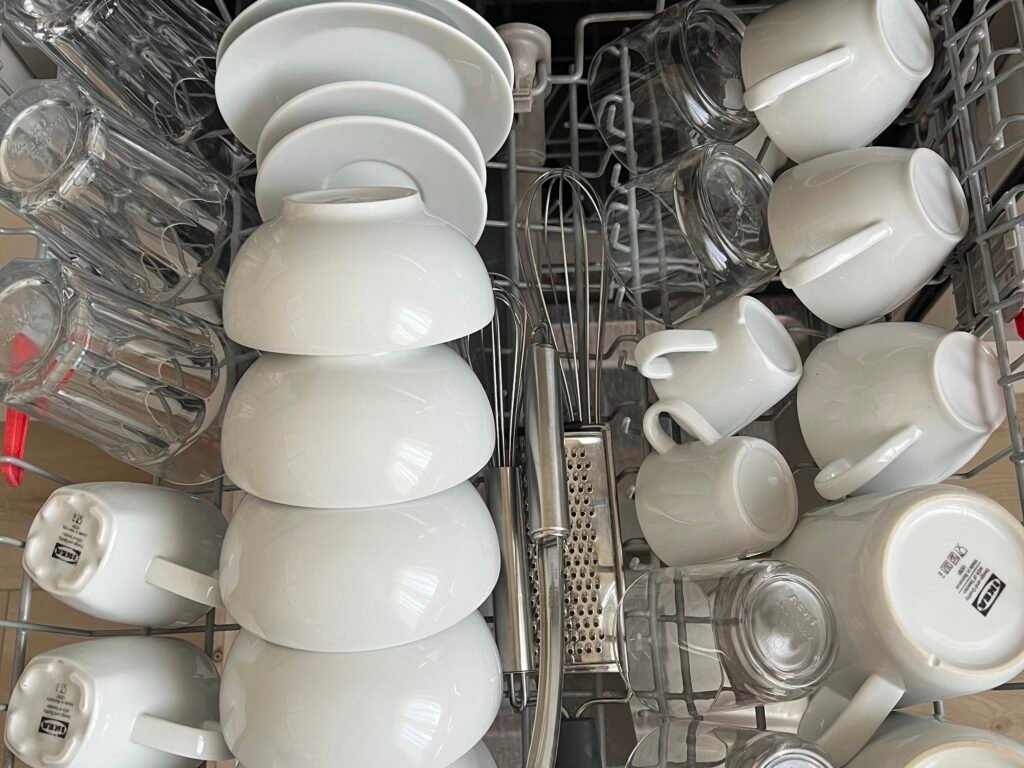
Do you feel the difference?
Even though this dishwasher actually contains more items, it feels dramatically easier to process. Because the dishes visually match each other, your brain automatically groups them together. Instead of processing 29 individual objects, your brain compresses the information into a small number of recognizable categories:
- glasses
- mugs
- bowls
- plates
- utensils
The amount of dishes is actually much larger, but the cognitive load is lower.
Now, when you go to empty the dishwasher, your brain immediately knows what belongs together. You can grab groups of matching dishes at once without needing constant mental processing or decision-making. The entire task feels calmer, clearer, and more predictable.
You can literally feel the reduction in stress just by looking at it.
And this is important, because your brain is constantly trying to reduce complexity by grouping information into patterns. When your environment supports that process, everyday tasks require dramatically less mental energy. But when everything is visually inconsistent, your brain has to keep actively sorting and analyzing the environment in real time.
That extra processing is exhausting. Especially for ADHD brains.
Why Matching Dishes Also Makes Loading Easier
This doesn’t just help when unloading. It also makes loading the dishwasher easier because grouping becomes intuitive.
When dishes match, bowls stack together naturally, plates align easily, mugs fit together predictably, silverware groups quickly, and containers organize more cleanly. Your brain no longer has to continuously solve tiny spatial puzzles while loading the dishwasher.
The system becomes predictable, and predictability lowers stress.
Why You Should Always Empty the Dishwasher in the Same Order
The second major mistake people make is choosing dishes randomly.
They open the dishwasher and continuously decide what to grab next. That means the brain is making fresh decisions during the entire task, which again increases cognitive load.
Instead, you want to create a fixed procedural sequence. Ideally, that sequence should follow a logical physical path through your kitchen.
For example, you might start with the leftmost cupboard:
- put away everything on the top shelf first
- then the middle shelf
- then the bottom shelf
Then move to the next cupboard and repeat the same pattern: top shelf, middle shelf, bottom shelf.
Continue this until the dishwasher is empty.
Now your brain no longer has to decide what to do next because the sequence already exists.
Why Fixed Sequences Feel So Much Easier
When you repeat the same unloading sequence over and over, your brain gradually stores it in procedural memory, which is the same system responsible for automatic behaviors like brushing your teeth, washing your hands, tying your shoes, or driving a familiar route.
That’s why those tasks feel easy: your brain already knows the sequence.
And your dishwasher routine can become the same way.
At first, you may still need to think about the order consciously. But after enough repetition, the process stops feeling like a new problem to solve and starts feeling automatic:
Open dishwasher → top shelf dishes → next shelf → next cupboard → silverware → done.
Minimal thinking, decisions, stress, and low cognitive load.
Instead of forcing yourself harder, you reduce the amount of thinking your brain has to do. And when a task becomes predictable and proceduralized, your nervous system starts treating it like a familiar pattern instead of mentally demanding work.
Why the Dishwasher Eventually Starts Feeling Easy
Emptying the dishwasher feels difficult mainly because of high cognitive load.
Matching dishes allow your brain to group items together automatically, while unloading the dishwasher in the same logical order every time removes unnecessary decisions. Together, these dramatically reduce the amount of mental processing required.
Over time, the sequence becomes stored in procedural memory, and the task starts feeling increasingly automatic and effortless.