
Why Building New Habits Feels So Hard With ADHD
People often think habit-building is about discipline, motivation, or “wanting it badly enough.”
But habits are actually much more like pathways your brain learns through repetition.
And once you understand how those pathways work, habit-building suddenly starts making a lot more sense.
Your Brain Is Standing at the Entrance of a Forest
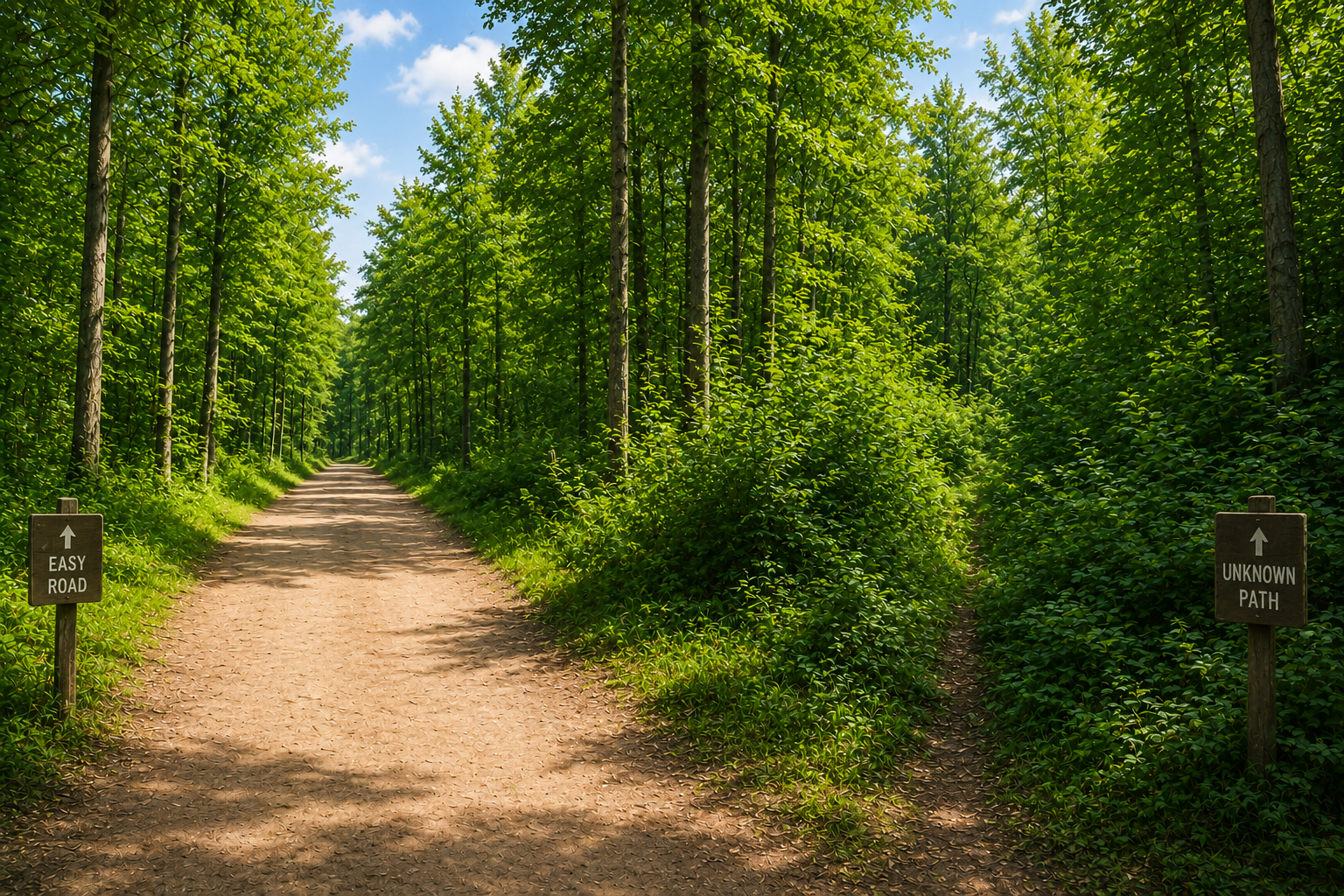
Imagine your brain standing at the entrance of a forest.
In front of it are two different paths.
The first path is wide, clear, and deeply worn into the ground.
You’ve walked this path 100,000 times before.
Every single day you travel it, your footsteps keep the trail visible and easy to follow. The dirt is packed down. The branches are pushed aside. The route is obvious.
Your brain knows exactly where this path goes.
It knows exactly how difficult it is.
Exactly how long it takes.
Exactly what waits at the end.
And because you’ve traveled this path so many times before, moving through it barely requires conscious effort anymore.
You don’t have to stop and think about where to step.
You don’t have to carefully analyze the route.
Your brain can practically walk the path on autopilot.
It’s smooth.
Familiar.
Automatic.
Your brain can travel this route while barely paying attention at all, because the sequence has been repeated so many times that it no longer requires much mental energy.
That path feels safe.
Now look at the second path.
At first, it barely even looks like a path at all.
The trees are thicker.
The ground is uneven.
There are branches everywhere.
You can’t fully tell whether it’s actually a real trail or just an area where the trees happen to be spaced farther apart.
And your brain has to decide which path to take.
Of course your brain wants the old path.
Why wouldn’t it?
The old path is predictable.
Certain.
Easy to follow.
Neurologically efficient.
Your brain is designed to conserve energy and avoid uncertainty whenever possible.
But there’s one reason you might decide to try the new path anyway:
You think it might lead somewhere better.
Maybe the old path leads somewhere disappointing.
Maybe it leads to stress, shame, exhaustion, poor health, unfinished goals, or a life you no longer want.
And maybe this new path — difficult and uncertain as it is — might eventually lead somewhere beautiful.
A healthier body.
A cleaner home.
More peace.
Success.
Confidence.
A future you actually want.
So your brain makes a calculation:
“This path is harder… but maybe the destination is worth it.”
That’s motivation.
Motivation is often just your brain deciding that a potentially better future might justify the uncertainty and effort of trying a new route.
So you force yourself down the new path.
And at first, it’s exhausting.
You have to push branches away manually.
You trip over roots.
You constantly second-guess yourself.
Part of your brain keeps thinking:
“Why aren’t we just taking the easy road we already know works?”
And this is exactly what building a new habit feels like.
Why Some Days You Fall Back Into Old Habits
Now imagine waking up exhausted, overwhelmed, emotionally drained, stressed, or low on dopamine.
Suddenly the new path feels much less appealing.
The difficult terrain no longer feels worth the energy cost.
Your brain starts thinking:
“I know the old path doesn’t lead somewhere amazing… but at least I know where it goes.”
“I know I can survive it.”
“I know I can handle that destination.”
“And honestly? I just do not have the energy to fight my way through an unfamiliar path through the forest today.”
So your brain falls back onto the old path again.
Not because you failed.
Not because you secretly want your old life more.
Not because you lack discipline.
But because your brain is constantly balancing:
- uncertainty
- effort
- energy availability
- and expected reward
And on low-energy days, the familiar path often feels safer than the exhausting uncertainty of building a new one.
How the New Path Slowly Becomes Easier
But something important happens every time you take the new path.
Your footsteps slowly flatten the grass.
The route becomes easier to recognize.
The branches get pushed aside.
The ground becomes more stable.
The path starts becoming real.
And meanwhile, something else is happening too:
The old path is no longer being maintained.
Nature slowly starts reclaiming it.
Grass grows over it.
Branches fall across it.
The route becomes less obvious.
At first, the old path is still much easier to travel.
But eventually, after enough repetition, the balance begins to shift.
The new path becomes clearer.
The effort decreases.
Your brain becomes more certain that the route works.
And once the new path becomes roughly equal in difficulty to the old one, something really important happens:
Now the brain starts comparing destinations.
And if the new path clearly leads somewhere better?
Your brain starts choosing it more and more automatically.
Not because of discipline anymore.
But because:
- the path is now easier to travel
- the route is now more predictable
- and the reward at the end is now believed strongly enough
Eventually the old path becomes so overgrown and inconvenient that the new path simply becomes the obvious choice.
That’s when a habit finally starts feeling natural.
Not because you “forced yourself forever.”
But because the brain eventually updated which path it believes is the best one to take.
Why Missing a Few Days At the Beginning Matters So Much
This also explains why habits can feel surprisingly fragile at first.
When the pathway is still weak, consistency matters enormously.
If you stop walking the new path for a while, nature starts reclaiming it again.
The grass grows back.
The route becomes harder to recognize.
The old path suddenly feels easier again.
That doesn’t mean all your progress disappeared.
It just means the new path wasn’t fully stabilized yet.
And that’s normal.
The first few times someone walks through a forest, the trail barely exists.
But eventually, with enough repetition, the ground itself changes.
So if your new habits still feel difficult, awkward, or unnatural…
that does not mean your brain is failing.
It usually just means the old path is still easier to travel than the new one.
And every repetition matters more than you think.
If you miss a day or two, remember that it’s not a failure on your part. There was a reason why your brain defaulted to the old path temporarily. Just pick up where you left off.
Because each time you choose the new path:
- the route becomes clearer
- the brain becomes more certain
- the effort decreases
- and the old path weakens a little more
Remember, you are not “trying to become disciplined.”
You are slowly teaching your brain that there is now a better path through the forest.